Crayon Back to School: A Designer’s Stitch Review
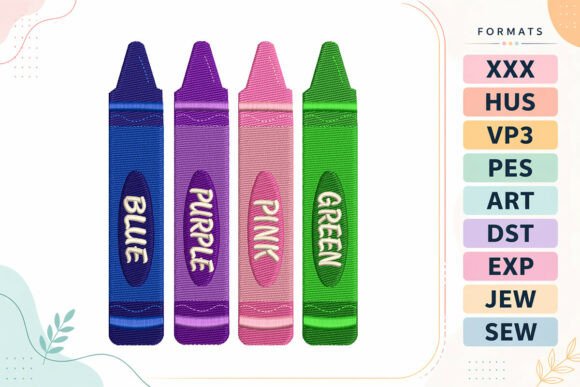
As an embroidery designer who has digitized and tested countless motifs for commercial and personal use, I approach every new machine embroidery design with a critical eye. It is not enough for a graphic to look good on a screen; it must translate beautifully through needle and thread. When evaluating the Crayon Back to School design, my immediate focus is on its practical application for real-world projects. Featuring four vibrant crayons in blue, purple, pink, and green arranged in a clean layout, this design immediately signals versatility. It avoids the cluttered aesthetic that often plagues seasonal artwork, offering instead a balanced composition that respects the physical limitations of fabric while delivering high visual impact.
First Impressions and Visual Balance
The first thing I noticed about Crayon Back to School is the intentional spacing between elements. In embroidery, negative space is just as important as the stitched areas. This design understands that principle. The four crayons are distinct without being disconnected, creating a cohesive unit that feels playful yet organized. For a craft business or Etsy seller, this clarity is vital. Customers browsing thumbnails need to instantly recognize the theme without squinting at muddy details. The color palette suggests specific thread colors that are likely standard in most commercial and home machine palettes, reducing the friction of sourcing materials. Visually, it strikes a mood that is nostalgic but fresh, making it suitable for both children’s items and adult apparel that celebrates teaching or school spirit.
Real-World Application: The Teacher Tote Test
To truly judge this embroidery file, I mentally placed it into a current project scenario: customizing canvas tote bags for a local teacher appreciation event. Teachers carry heavy loads, and their bags endure significant wear. This is where the design’s layout shines. Because the crayons are arranged cleanly, the design can be centered on a tote bag design without competing with seams or handles. I envision pairing this with a simple name in a sans-serif font below the crayons to create a personalized gift. The linear arrangement of the crayons also makes this an excellent candidate for sweatshirt embroidery across the chest or yoke area, rather than just a standard left-chest placement. For small shop product lines, this adaptability means one digital asset can serve multiple SKUs, from baby bibs to adult aprons, maximizing the return on your design investment.
Fabric Compatibility and Stabilizer Strategy
While the layout is forgiving, the execution depends entirely on your substrate. Crayon shapes typically involve a mix of satin stitch outlines and fill stitch bodies. If you are stitching this onto a textured fabric like terry cloth or fleece for baby embroidery, you must account for pile push-down. I recommend using a water-soluble topping to ensure the satin edges remain crisp and the fill stitches do not sink into the fabric nap. Conversely, if you are working with thin, stretchy knits for custom apparel, the stabilizer choice becomes non-negotiable. A fusible cutaway is often best here to prevent the design from distorting the garment shape over time. Always check the stitch density before committing to a production run; if the design is too dense for lightweight cotton, you risk puckering that no amount of pressing will fix.
Navigating Hoop Sizes and Detail Limits
One caution for makers using smaller machines: verify your hoop size compatibility before purchasing. While four crayons fit beautifully in a 5x7 or larger hoop, resizing this design down to a 4x4 field requires care. Reducing the size may cause the waxy texture details or facial features on the crayons to become lost or cause thread breaks due to overcrowded stitches. If you plan to use this as an embroidered patch or for detailed corners on a collar, test the minimum viable size first. Additionally, consider the background fabric color. These specific blue, purple, pink, and green threads will pop against white or cream but may require a white underlay or outline if stitched onto dark navy or black fabric to maintain contrast and definition.
Commercial Viability for Makers and Sellers
For those running a handmade product business, Crayon Back to School offers strong commercial potential because it transcends a single demographic. It works for holiday embroidery during back-to-school season, but also for year-round teacher gifts, homeschool co-op merchandise, and library volunteer apparel. However, professionalism lies in the finishing. Before listing any finished product for sale, create a printable mockup or photograph a physical sample to verify color accuracy. Digital previews can sometimes misrepresent how variegated or solid threads interact with the design’s fill patterns. Furthermore, always confirm the licensing terms of the digital embroidery file. Ensure you have the right to sell physical items embroidered with this design, especially if you are scaling up for commercial embroidery production. Trust is built when customers see consistent, high-quality stitching that matches the promised aesthetic.
Designer Notes for Optimal Results
Based on my evaluation of similar vector-to-stitch conversions, here are my practical recommendations for getting the best results from Crayon Back to School:
- Test Stitch First: Never run this design directly on a final product without a test sew-out on similar scrap fabric. Check for registration issues between the outline and fill.
- Thread Contrast Check: View your thread selection in natural light. The purple and blue should be distinct enough that they don't blend together on camera for product photos.
- Stabilizer Matching: Use tear-away for stable woven fabrics like denim or canvas, and cutaway for knits or performance wear to maintain structural integrity.
- Mockup Validation: If selling digital assets or using this for print-on-demand integration, ensure your design assets accurately reflect the stitch texture, not just flat vector art.
- Wash Testing: If intended for baby embroidery or kitchen linens, wash and dry your test sample three times. Crayon tips and satin borders are stress points that can fray if the density is insufficient.
- Licensing Compliance: Double-check whether the license covers both personal gifting and commercial sale of custom apparel or patches.
Final Verdict on Project Suitability
Crayon Back to School is a robust, well-conceived design that earns its place in a professional digitizer’s library. It balances whimsy with technical soundness, avoiding the common pitfalls of overly complex seasonal art. Whether you are creating a personalized gift for a favorite educator or building a capsule collection for your Etsy seller shop, this design provides a reliable foundation. Its success ultimately relies on your attention to fabric pairing and stabilization, but the underlying artwork does the heavy lifting. By respecting the technical requirements of the embroidery project, you ensure that the final result is as vibrant and durable as the crayons depicted, bringing genuine value to your clients and joy to your creative process.